Uncategorized

Tuesday Tip-Bread Flour

My bread and roll making took a turn for the better a few years ago when I discovered King Arthur Bread Flour.  My breads when from alright, to a highlight at the meal.  Bread flour has a higher protein content than all-purpose flour.  It provides more structure for breads than all-purpose flour.

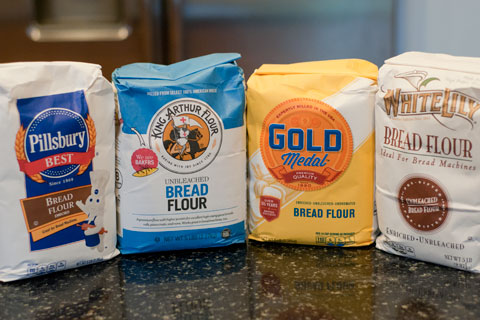
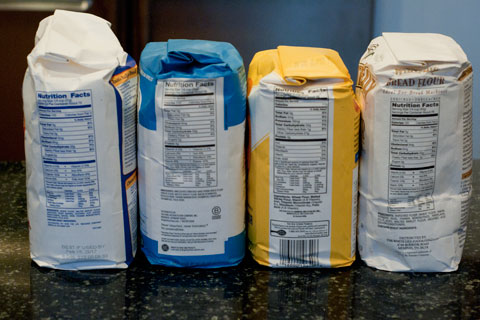
I wanted to conduct an experiment to see if the brand of bread flour I used mattered.  I used Pillsbury Best, King Arthur, Gold Medal, and White Lily (which I had a hard time finding in a store but ordered from Jet.com for $2.78 for 5 lbs, delivered).

I then gave my family a blind taste test of Our Best Bites World’s Best Dinner Rolls, to see which one they preferred. (I cut the recipe in half and started with 21.5 ounces of flour).  I weighed the flour for each different brand.  The King Arthur and Gold Medal batches both needed 4 extra tablespoons of flour (approx. 1.6 ounces).  White Lily took 2 extra tablespoons (approx. 0.8 ounces), and Pillsbury worked great with the amount the recipe calls for.  Turns out, they were all pretty similar in taste and texture, except for the Pillsbury brand.  It had an aftertaste we didn’t like.  As for the other three, we had a very slight preference for King Arthur and While Lily over Gold Medal.  My rank list went as follows, but the top three were really almost a tie:

1.  King Arthur
2. White Lily
3. Gold Medal
4. Pillsbury Best

Going forward, I think we’ll be switching to White Lily because I can get it delivered to my door for almost half the price.

(Note:  These are completely my own opinions.  I did not receive any compensation from any of the brands or stores mentioned in the this post.)

Uncategorized

Tuesday Tips-Oven Bake Your Bacon

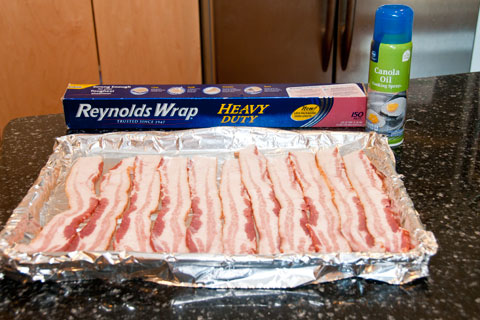
I LOVE bacon, but I hate to fry it on the stove top.  It makes a huge mess and the bacon smell just sticks to me.  So, I started baking my bacon in the oven.  I cover a cookie sheet with aluminum foil (I use the 18″ width kind for this job), spray it with non-stick spray, and spread the bacon in a single layer across the pan.  The non-stick spray really is an important step.  I know bacon has plenty of fat in it, but the bacon sticks if I don’t spray it first.  Bake at 425 degrees for 15-23 minutes, depending on how crispy you like it and how thick your bacon is.  I like my bacon thick and crispy!


After it’s done cooking, I fold one hot pad in half and set the pan on it and a flat one so that it create a tilt. 

Place the pan on the folded hot pad as well as a flat one for the other end.  I push the bacon to the top half and let the grease run down to the bottom.

Remove the bacon and place on paper towels to absorb any extra grease.  Once the pan cools a bit, I put a couple of paper towels down to soak up/contain the grease, fold the foil up into a neat little packet, and throw it in the garbage.  No mess no fuss.  If I cooked any extra bacon, I crumble it up and store it in the fridge for bacon bits.

Uncategorized

Tuesday Tips-Weigh Your Flour

This is the first of a series of Tuesday’s Tip of the Week.  Today’s tip is weigh your flour.  When baking, getting the right amount of flour in a recipe can be tricky.  Usually, you add the minimum amount of flour a recipe calls for and then add more, a little at a time, in order to get the right texture. 

Remember in Home Ec in school, your teacher would have you sift the flour before adding it to the recipe.   For me, it was way more effort that it was worth because I thought it was a texture thing.  Turns out that it is a volume thing. The more packed a cup of flour, the more flour you get per cup.  So, when using volume to measure, you can get widely varying amounts of flour in a recipe.  Sifting the flour first gives you a more consistent volume of measure.  However, I think there is yet a better and easier way.

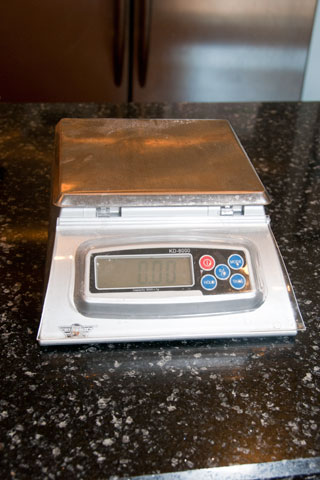
A few years ago, we purchased a kitchen scale, and I started weighing our flour.  Turns out that weight is a far more consistent way to measure flour.  The conversion factor for flour should be:

1 cup flour = 4.92 ounces

Not all recipes are created equal, and you may have to play around a bit with the recipe to get the correct weight of flour, but the conversion factor is a great place to start.  Once I figure out the correct weight of the flour for a recipe, it takes out all the guess work.  I just add the correct weight of flour and the recipe turns out every time.  I don’t need to tweak anything.  It is definitely a time saver, and my recipes turn out more consistently each time.